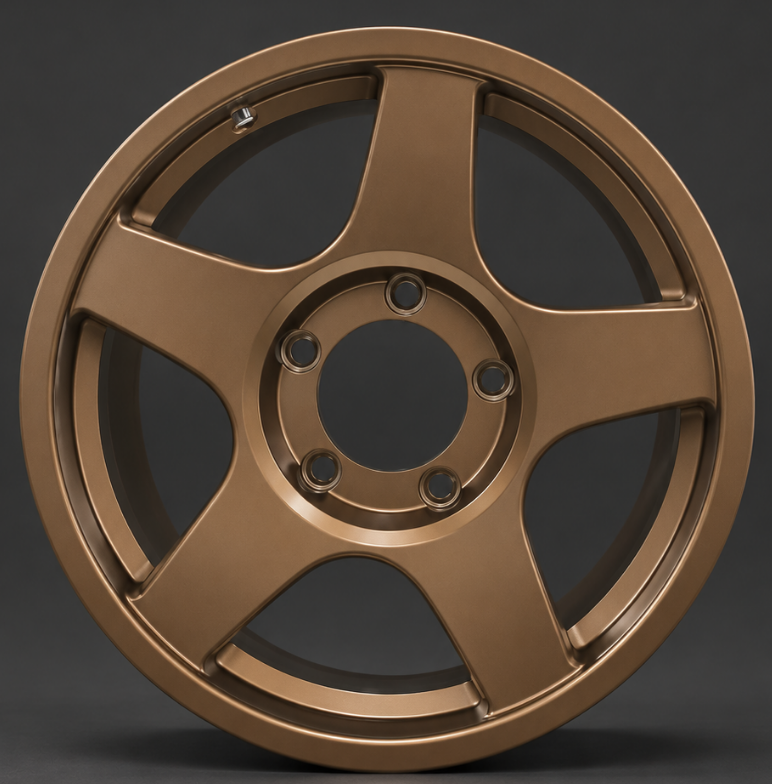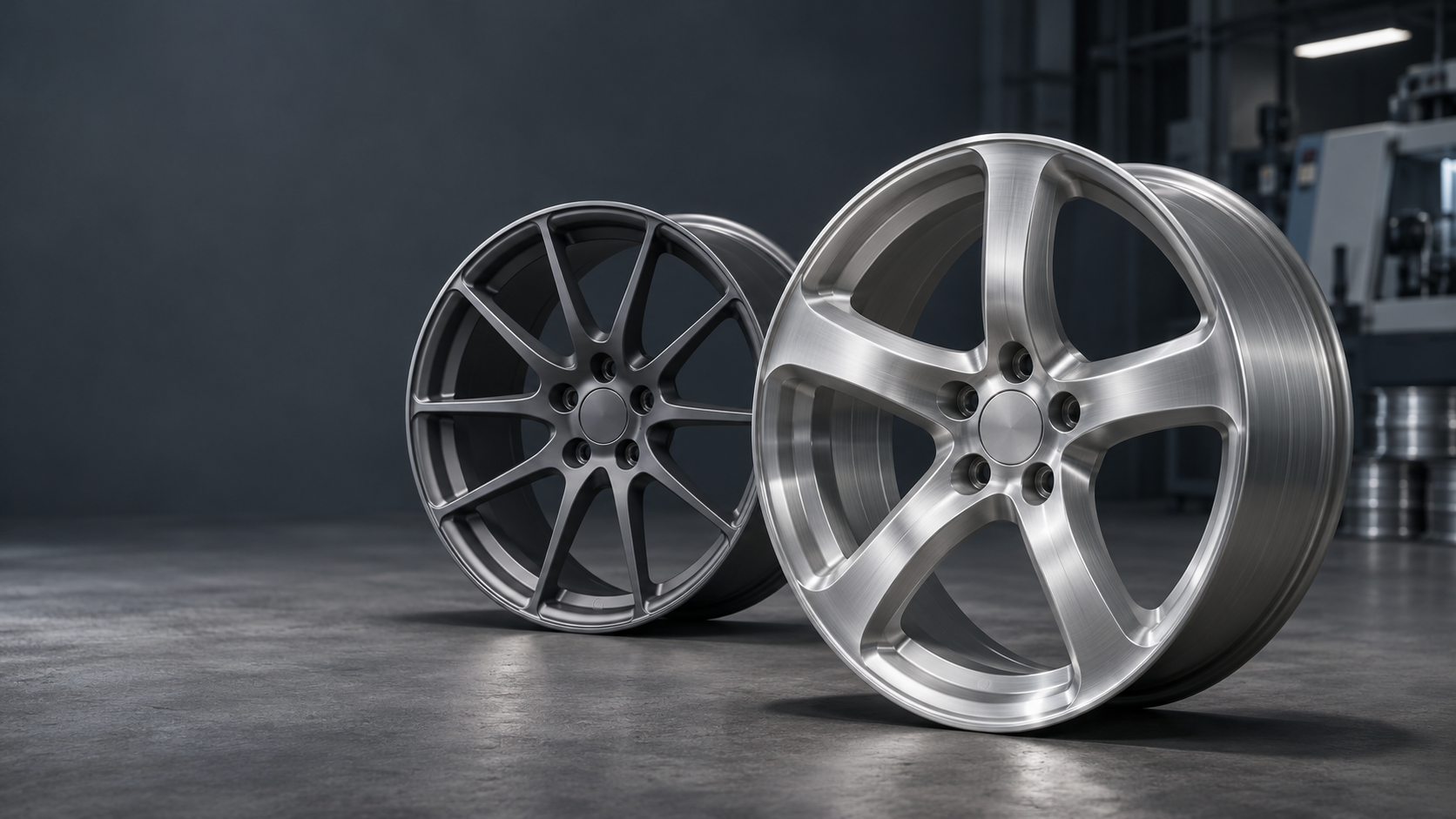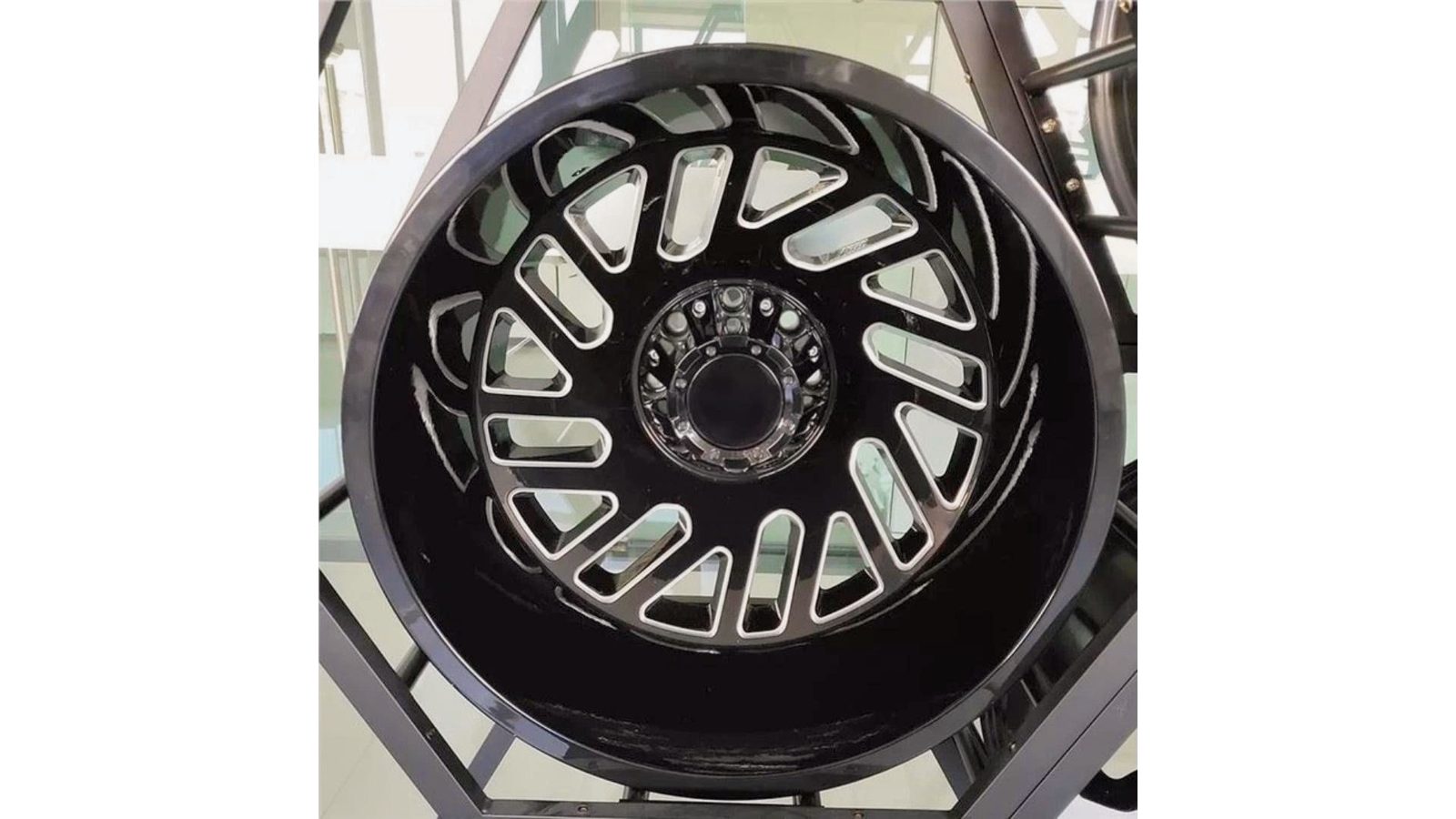
Why an off-road wheel fails differently from a road wheel, how much of its strength comes from geometry rather than material, and which fitment numbers decide whether a build works in the dirt or only in a photograph.
Offroad forged wheels operate in a load environment that road wheel design does not describe well. A tyre with a tall sidewall and low pressure is a compliant spring that transmits a different kind of force into the rim: long, slow, high-amplitude loads from rocks and ledges, sudden lateral loads from sidewalls being pushed against obstacles, and occasional very high impacts from landings rather than potholes.
The result is a wheel that needs thickness in different places from a performance road wheel. The flange and bead seat take abuse that a low-profile tyre never delivers, the spoke has to resist bending from a tall sidewall lever rather than from cornering grip alone, and the finish has to survive mud, salt water and pressure washing without corroding at the first chip.
This article covers the structural logic of an off-road wheel, the difference between a wheel that is merely large and one that is actually reinforced, the beadlock question, the fitment numbers that matter on a lifted vehicle, the corrosion and finish decisions that determine how the product looks after two winters, and the inspection points a buyer should require.
The Loads an Offroad Wheel Actually Sees
The first load is radial impact at the flange. A tall tyre at low pressure deforms over a rock and then the rim contacts the obstacle directly, and that contact happens at the outer flange where the section is thinnest. A road wheel rarely sees this because a low-profile tyre transmits the hit through the suspension instead of bottoming onto the rim.
The second is lateral load through the sidewall. When a tyre is pushed sideways against a rock or a rut, the sidewall acts as a lever on the bead seat and the flange, producing a bending moment that a road wheel's geometry is not sized for. That is the load that deforms lips and starts bead leaks on wheels that were designed only for vertical impact.
The third is the landing load. A vehicle leaving a ledge or a dune crest lands on all four corners with a vertical force that can exceed several times the static weight, and that force arrives through the tyre, the wheel and into the suspension in a single event. A wheel that passes a standard impact test at its rated load may still see higher peak loads in this scenario.
The fourth is fatigue from sustained low pressure. A tyre running at low pressure allows the bead to move slightly on the seat with every rotation, and that micro-movement frets the seat over thousands of kilometres. It is a slow wear mechanism rather than a single failure, and it is the reason bead seat surface finish matters more on an off-road wheel than on a road wheel.
Where the Strength Comes From in Offroad Forged Wheels
The flange is the first place a reinforced design differs. A thicker flange with a larger outer radius spreads an impact over more material and resists the lip rolling over a rock. It also gives the bead more support at low pressure, which is why heavy-duty off-road wheels often look visually chunkier at the rim edge than performance designs.
The second is the spoke root. A tall sidewall produces a longer lever arm, so the bending moment at the spoke root is higher for the same lateral force. Material added at the root, and a generous radius at the transition, is what prevents the crack initiation that appears on wheels that were designed as scaled-up road wheels.
The third is the hub. Large-diameter off-road wheels carry heavy vehicles and large brake packages, and the hub has to transmit braking torque without distorting the mounting face. A hub that is too thin will not stay flat after a few seasons of heavy use, and a mounting face that is not flat produces vibration that no balance will fix.
Forging contributes to all three by allowing a continuous grain structure through the spoke and into the barrel. On a wheel that is loaded in many directions, that continuity matters more than a nominal strength figure, because the failure mode being designed against is crack initiation at a transition rather than bulk yielding.
| Feature | Road-Oriented Design | Off-Road Reinforced Design |
|---|---|---|
| Outer flange | Light, with a narrow lip | Thicker, with a larger radius and more bead support |
| Spoke root | Sized for cornering moment | Sized for sidewall lever and landing loads |
| Barrel wall | Thin for inertia and airflow | Thicker at the seat to resist distortion |
| Hub thickness | Moderate | Deeper, to hold flatness under heavy braking |
| Finish | Cosmetic priority | Corrosion priority, with chip resistance |
| Valve protection | Rarely considered | Recessed or shielded, because a valve is easily torn off |
Beadlock or Conventional: The Decision That Changes Everything
A functional beadlock clamps the tyre bead mechanically and allows pressures that a conventional bead cannot hold. For a vehicle that runs dunes, rocks or deep mud at low pressure, that capability is the difference between a usable contact patch and a tyre that debeads at the worst moment. It also adds mass at the outermost radius, a torque routine and a legal question in several markets.
A simulated beadlock delivers the visual proportion without the clamp. It stays lighter, remains legal for road use in most places and needs no maintenance, which makes it the right answer for a vehicle that mostly runs highways and occasional gravel. The mistake is to sell one as the other, and buyers should ask directly which type a wheel is.
A hybrid design sits between them, with a ring that provides partial retention without a full split-rim clamp. Its capability depends entirely on the contact geometry between ring and bead, which is why the specification has to describe that contact rather than the bolt count. Our inner beadlock off-road forged wheel is an example of how the retention feature can be integrated into a design without turning the whole wheel into a race-style split rim.
The decision should be made from the tyre and the terrain, not from a style reference. A 37-inch mud tyre at 1.2 bar on a heavy vehicle needs a clamp; the same vehicle on a 33-inch all-terrain at road pressure does not. Getting that wrong in either direction costs either capability or comfort.
Questions that decide the beadlock question in one conversation:
- What tyre size and construction will the vehicle run, and at what pressure on the terrain it is built for
- How much of the annual mileage is highway, because a clamp is a liability there rather than an asset
- Whether the destination market permits a functional beadlock on a road-registered vehicle
Fitment Numbers on a Lifted Vehicle
Diameter and width are the visible numbers, and they are the least likely to cause a problem. A larger diameter raises the vehicle and changes the gearing, while a wider tyre increases the scrub radius and the load on the hub. Both are manageable within reason, and both should be decided against the suspension and driveline rather than against the arch alone.
Offset is the number that decides whether the build works. A lower offset pushes the wheel outward, which clears the inner suspension and gives the stance most owners want, but it also loads the outer arch and increases the scrub radius. On a lifted vehicle with a large tyre, the combination can produce rubbing at full articulation that never appears on flat ground.
Backspacing is the same dimension expressed differently, and it is the one that matters for inner clearance. A wheel that clears the brake caliper can still contact the suspension arm or the inner arch at full lock, and that contact is only found by cycling the suspension with the tyre fitted rather than by measuring a static gap.
Load rating has to be stated for the built vehicle. A lifted truck with a bed rack, a roof tent and a full load of recovery gear sits well above its kerb weight, and the wheel's rating should be confirmed against that figure rather than against the manufacturer's published weight of a standard vehicle.
Weight, Gearing and Driveline Consequences
A larger off-road wheel changes more than appearance. Increasing the rolling radius raises the effective gearing, so the engine turns fewer revolutions for the same road speed and the vehicle feels slower to accelerate. On a diesel or a modern turbocharged engine the effect is often acceptable; on an older naturally aspirated vehicle it can make the build feel sluggish, which is why re-gearing is a common companion modification.
Mass matters more than diameter for braking. A heavy off-road tyre and wheel assembly adds rotational inertia that the brakes have to slow, and it adds unsprung mass that the suspension has to control. On a vehicle that already carries a heavy tyre, choosing a lighter forged wheel is one of the few ways to claw back response without changing the tyre size.
Hub and bearing load is the third consequence. A wider offset and a heavier assembly increase the bending moment at the hub flange, which shortens wheel bearing life and can accelerate wear at the hub itself. That is not a reason to avoid the build, but it is a reason to keep the offset increase modest and to use a wheel whose hub is designed for the load class.
Steering feel is the fourth. A larger scrub radius from a lower offset produces heavier steering at low speed and stronger kickback over rocks, which on a manual steering vehicle can be tiring on a long trail. A hydro assist or a steering damper is often added at the same time for that reason.
None of these effects is a defect in the wheel. They are the system consequences of a build decision, and a supplier who understands them can advise on the combination rather than only on the part. That advice is worth more than a marginal difference in weight between two similar designs.
It is also worth deciding the build as a whole before ordering. Tyre, wheel, suspension and gearing interact, and changing one after the others are bought is how a project ends up with a set of wheels that fits the vehicle but not the plan.
Corrosion, Finish and the Second Winter
An off-road wheel lives in conditions that accelerate corrosion: mud that holds moisture against the surface, salt on winter roads, and pressure washing that drives water into every crevice. A finish that looks perfect in a showroom can fail at a stone chip within a season, and the failure usually starts at an edge where the coating is thinnest.
Powder coating is the most durable option for a heavily used off-road wheel because it produces a thick, continuous film with good chip resistance. Its weakness is at edges and threaded features, where the film can be thin or absent, so preparation and masking matter as much as the coating itself.
Anodising produces a harder surface with better dimensional control, and it performs well on machined faces that would show chips badly under paint. It is less effective as a standalone corrosion barrier on a rough casting-like surface, which is one reason forged and machined wheels anodise more predictably than cast ones.
Painted finishes with a clear topcoat sit between the two, offering good appearance and easier repair at the cost of lower chip resistance. For a buyer exporting to a wet or salted market, the sensible specification combines a durable base coating with a clear topcoat and a design that avoids sharp external edges where the film will be thin.
Customization That Survives Real Use
Off-road customization tends to be functional before it is decorative. A recessed valve position, a reinforced flange, a specific backspacing and a load rating for the built vehicle are the choices that determine whether the wheel works. Colour and spoke detail come after those are settled, not before.
- Beadlock ring finish. A contrast ring is the most visible upgrade, and a painted ring is easier to touch up than a polished one after rock damage.
- Valve shielding. A small feature that prevents a torn valve on a trail, and one that buyers forget to specify.
- Load-rated hardware. Studs, nuts and centre caps should match the load class rather than the cosmetics.
- Spare wheel consistency. The spare should share the offset and finish of the set, because a mismatched spare is discovered at the worst possible time.
- Replacement parts. Rings, hardware and centre caps should be orderable separately for the life of the wheel.
A second tier of customization involves new tooling: a different spoke count, a deeper concave or a new window shape. Those changes require a forging die and a machining programme, and they should be treated as a design cycle rather than as an order option. Our SSD off-road series exists so that most buyers can start from a proven geometry and reserve new tooling for programmes that genuinely need it.
Inspection and Test Evidence
Impact testing is the first item to request, and the angle matters. A radial impact test describes a pothole; an off-road wheel needs evidence at 30 and 90 degrees because that is how a flange meets a rock. A supplier who can only show a radial result has tested the easiest case.
Radial and cornering fatigue come next, at the load rating of the built vehicle rather than at a nominal passenger-car figure. The report should name the rating, the tyre diameter used and the test standard, because a fatigue result without those three parameters cannot be interpreted.
Coating tests are the third group. Salt spray exposure and a cross-hatch adhesion check on a production part describe how the finish will behave in a wet climate, and both are inexpensive to run. A buyer entering a salted-road market should ask for them rather than assume the finish is adequate.
Dimensional checks close the list: runout at the bead seat, hub face flatness and bolt pattern position, measured on production wheels rather than on a sample. On a heavy off-road wheel those tolerances matter more than on a light car, because a large tyre amplifies any deviation at the rim.
A batch-level record is the last item worth insisting on. Five wheels measured and logged per shipment, with the values retained against the production date, turns a quality claim into a trend the buyer can review. Without that record, every complaint becomes a conversation about opinion rather than a comparison of numbers.
How RETA Builds Offroad Forged Wheels
RETA has produced forged wheels in Ningbo since 2012, with the company founded in 2009, a 12,000 square metre plant and more than 100 staff. Off-road and heavy-duty work runs alongside the road range, with alloy and section thickness selected against the vehicle mass and tyre size rather than against diameter alone.
The quality system covers ISO 9001, ISO 14001, ISO 45001 and IATF 16949, with national high-tech enterprise status granted in 2021. Internal limits are held tighter than the SAE, JWL and PCT sequences we design to, and 30-degree and 90-degree impact and deformation tests are added because off-road damage arrives at angles a radial test never reproduces.
Commercially, the minimum order is one set of four wheels, standard sizes run in roughly 7 to 15 working days and fully custom designs take about 25 to 35 working days. Heavy applications that exceed passenger-car load classes can be specified from the military wheel range, which uses the same forging base with a higher load case.
We exhibit at SEMA, where the brand received the 2023 Best Innovative Wheel Brand Award. Off-road buyers there usually bring a tyre size, an inflation strategy and a vehicle weight, which is the right order of information; the customized off-road forged wheel can then be specified around those numbers rather than around a photograph.
Frequently Asked Questions
Q1. Are offroad forged wheels worth the cost over a cast wheel?
For a vehicle that is actually used off-road, yes. The forging allows a stronger flange and spoke root at a given mass, which is exactly where off-road damage occurs. For a vehicle that only sees gravel roads, a good cast or flow formed wheel may be adequate and cheaper.
Q2. Do I need a functional beadlock for sand driving?
Sand is the case where low pressure matters most, so a functional clamp has real value there, particularly on a heavy vehicle with a wide tyre. On lighter vehicles with narrower tyres, a conventional bead at a moderate pressure reduction is often sufficient.
Q3. How much offset change is safe on a lifted vehicle?
There is no universal number, because the limit depends on the arch, the suspension travel and the tyre width. The safe approach is to cycle the suspension through full articulation with the intended tyre fitted, and to confirm both inner and outer clearance before the specification is fixed.
Q4. Which finish lasts best on a salted winter road?
A properly applied powder coat or a painted finish with a clear topcoat generally outlasts a polished surface, which shows salt damage quickly. Whichever is chosen, edge coverage and preparation decide the result more than the coating type.
Q5. Can a large offroad wheel be repaired after a bent lip?
A minor bend in a forged lip can sometimes be corrected within a defined tolerance, and a multi-piece design allows the lip to be replaced outright. Cracks, heavy deformation or damage at a spoke root are not repairable, and a welded repair on a structural section should be refused.
Send us your tyre size, built vehicle weight and the terrain you actually drive, and we will specify offroad forged wheels with the flange, beadlock choice and offset matched to that use.
Browse the Forged Range Send Build Details